
FDM 3D printing explained
FDM 3D printing (fused deposition modelling) builds a part by melting plastic filament and laying it down in thin layers, one on top of the other. It's the most common type of 3D printing, and the one we use for every part we make.
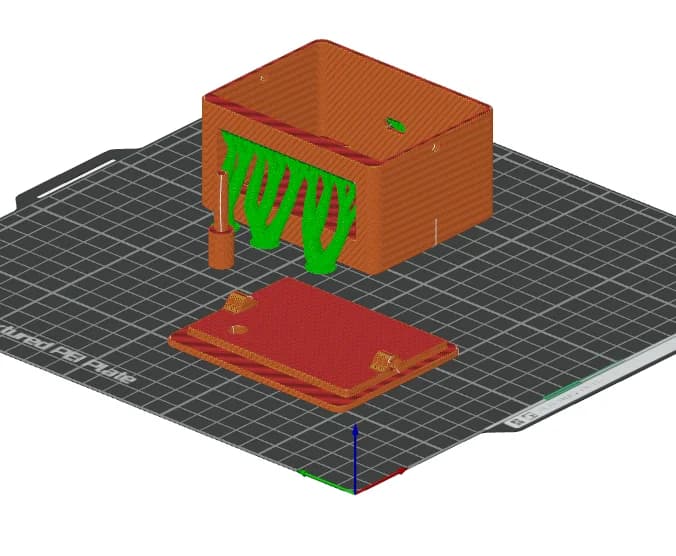
How does FDM 3D printing work?
Slicer software cuts your 3D model into hundreds of thin layers. The printer then melts filament in a heated nozzle and traces each layer, building the part from the bed up.
- 01
Model
Your design is exported as an STL (a mesh of triangles).
- 02
Slice
Software turns it into layers, walls, infill and supports.
- 03
Print
A hot nozzle lays down plastic, layer by layer.
- 04
Finish
Supports are removed and the part is checked and packed.
How strong are FDM 3D printed parts?
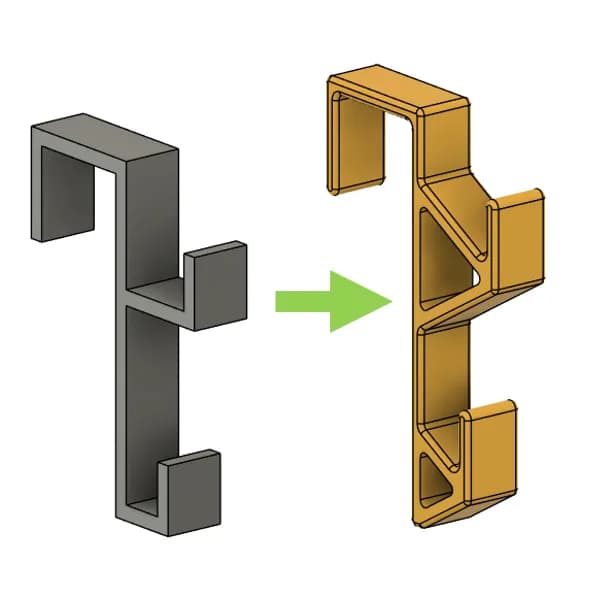
Strong along the layers and weaker across them, because each layer bonds to the one below. Orienting the part so loads run along the layers makes a big difference.
- More walls add more strength than more infill
- PETG is tougher than PLA; PLA is stiffer
- Fillets stop cracks starting at sharp corners
- Infill is usually 15–40%: parts aren't solid
How accurate is FDM 3D printing?
Typically within a few tenths of a millimetre. That's fine for most fits, but holes and sliding parts need a little extra clearance designed in.
- Add 0.2–0.3 mm clearance for parts that slide together
- Small holes print slightly undersize; drill to size if critical
- Fine details need to be at least 0.4–0.6 mm wide
- Single parts up to 330 × 320 × 325 mm
What is FDM printing best for?
Functional parts, prototypes, enclosures, brackets, replacement parts and larger models: anything where strength, size and cost matter more than microscopic detail.
- Compare PLA, PETG and TPU materials →Which filament suits your part.
- Large format 3D printing up to 330 mm →Big single-piece parts, and how larger ones are split.
- Multi-colour 3D printing in one piece →Up to four colours printed in, with no painting.
Want a second opinion before you print? Get a free design for 3D printing review.
What else do people ask about FDM printing?
Quick answers on terminology, finish and file types.
What does FDM stand for?
Fused deposition modelling. You'll also see FFF (fused filament fabrication), which means the same thing.
Is FDM or resin printing better?
FDM is better for functional parts, larger parts and tough materials. Resin (SLA/MSLA) captures finer detail, which suits tiny figures and jewellery masters. We only offer FDM.
Can FDM prints be smooth?
Layer lines are always slightly visible. Finer layers reduce them, and PLA sands and paints well if you need a smooth finish.
What file do I need for FDM printing?
An STL file for the instant quote. If you have a STEP, 3MF or native CAD file, send it through the contact form and we'll convert it.